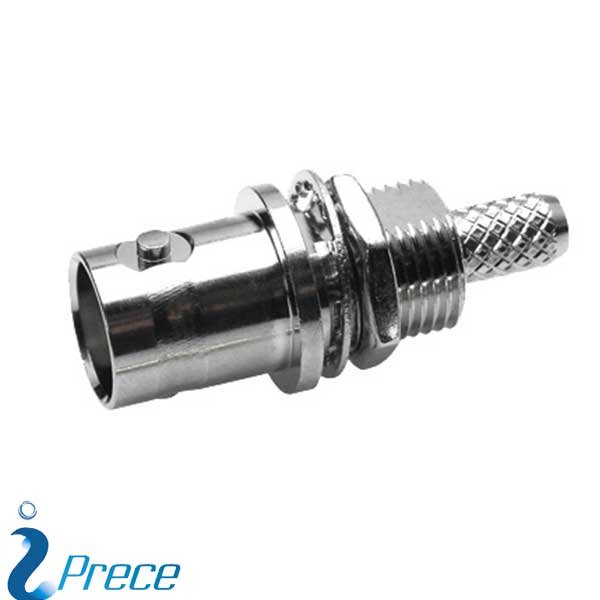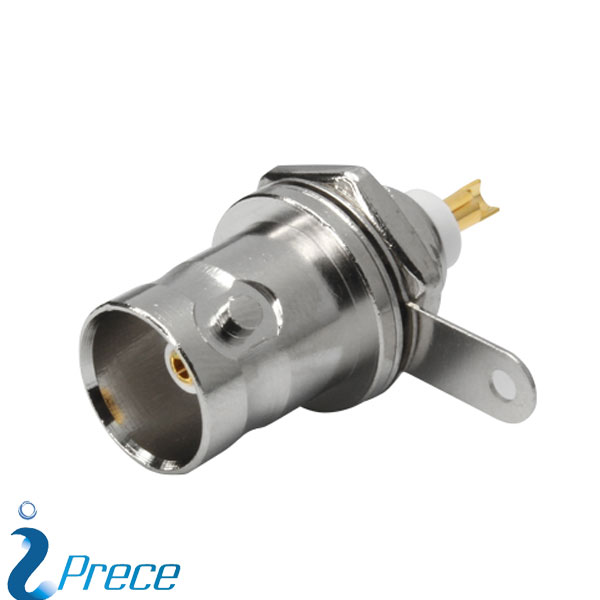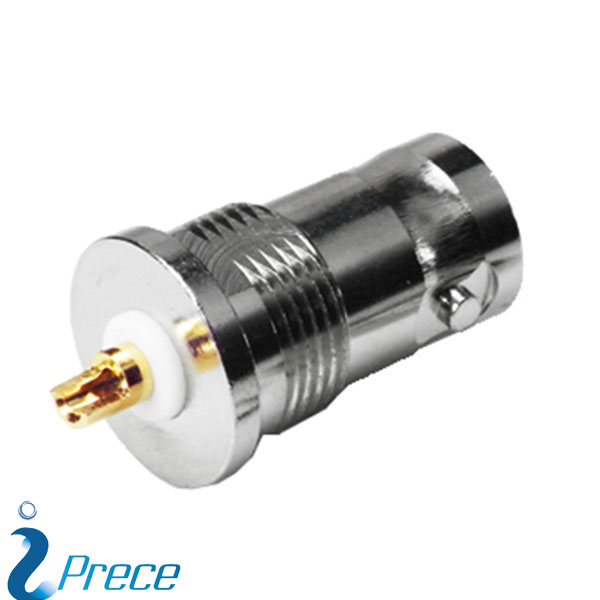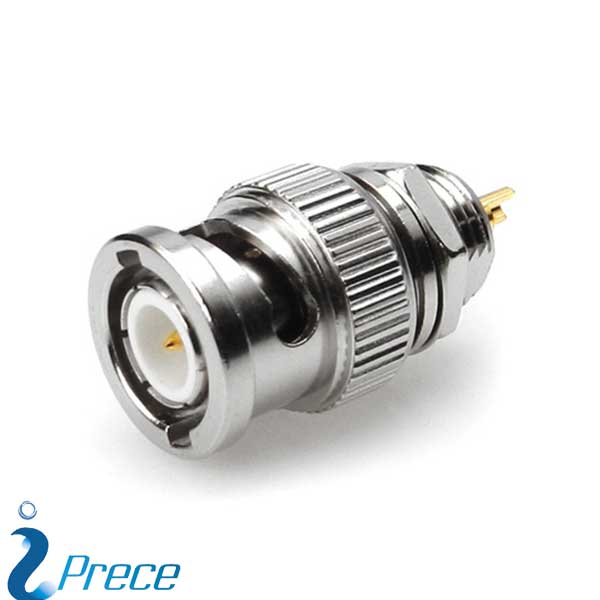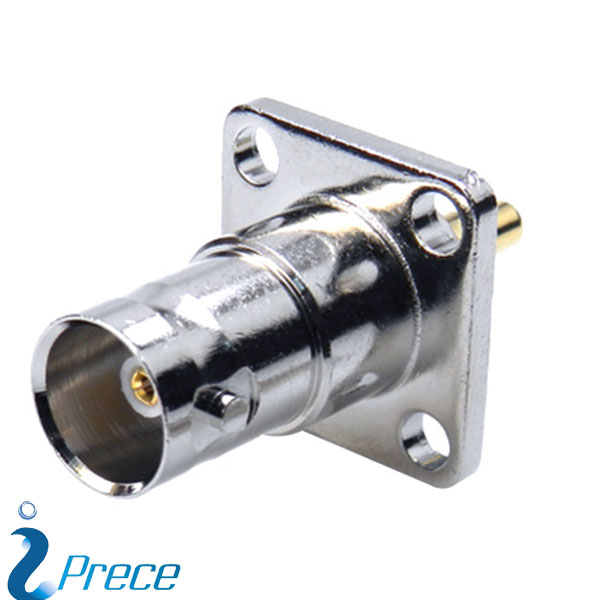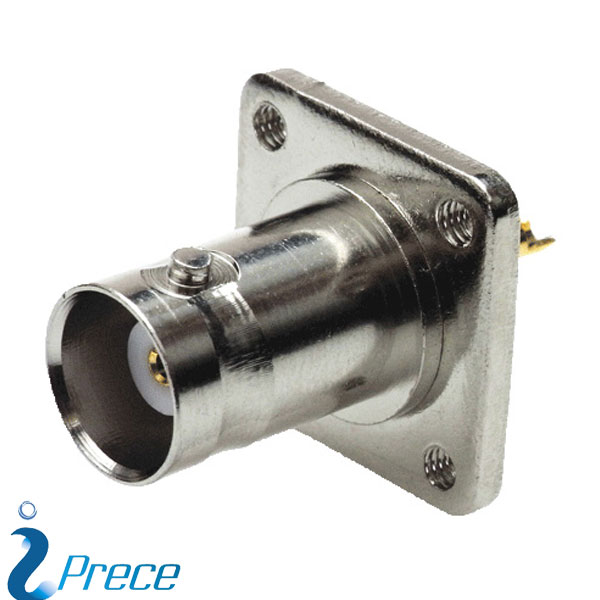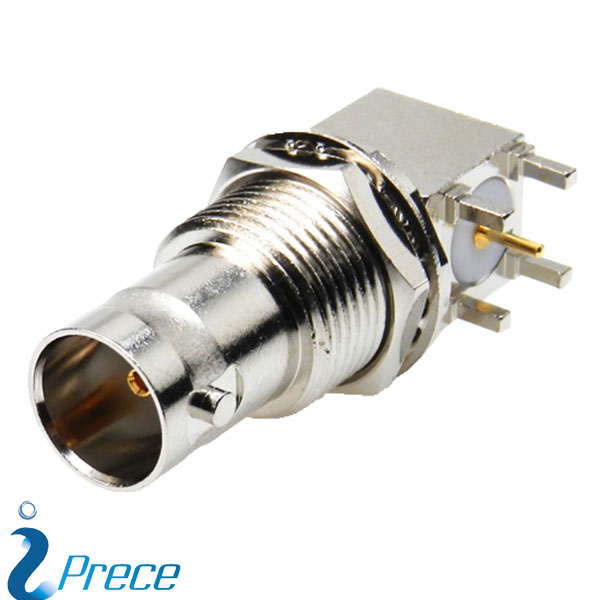






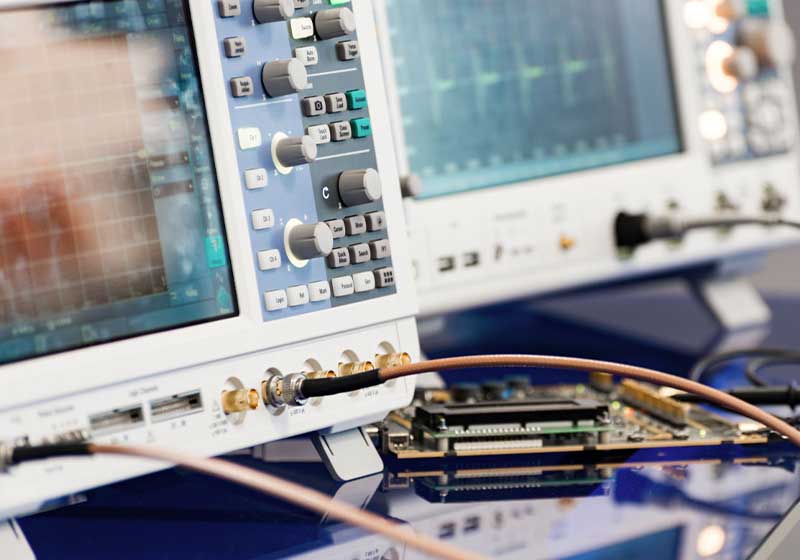
BNC Connectors
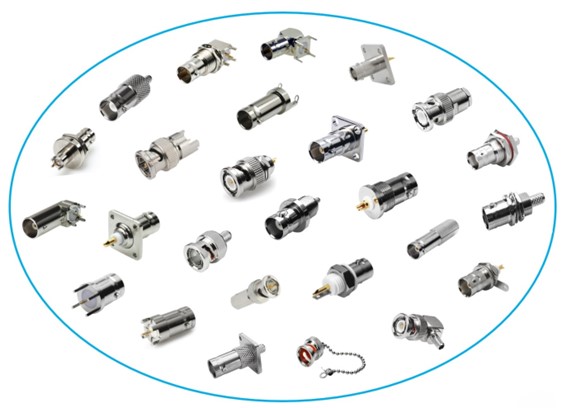
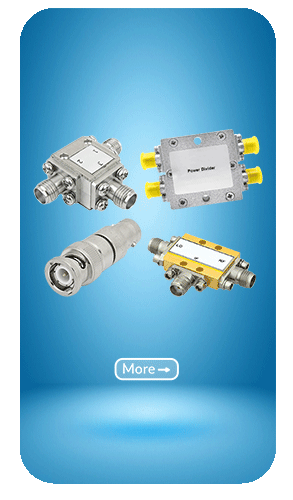
A BNC (Bayonet Neill–Concelman) connector is one of the most widely used RF connectors in the electronics industry. It provides a secure bayonet-style locking mechanism, enabling quick and reliable connections for coaxial cables across telecommunications, broadcasting, medical, and industrial applications. This document presents a fully optimized, long-form SEO content version designed for iPrece, with technical details, applications, advantages, comparisons, and FAQs to maximize online visibility and search engine performance.
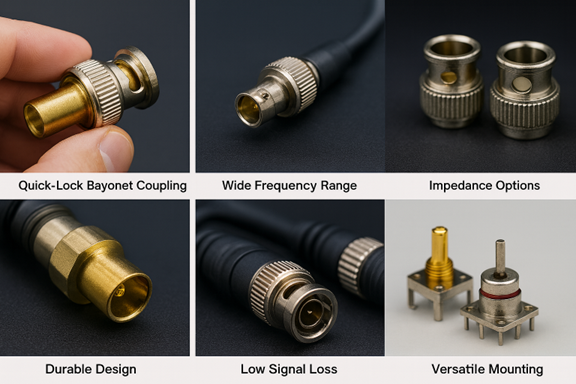
Key Features & Benefits of BNC Connectors
- Quick-Lock Bayonet Coupling – Secure and simple quarter-turn locking system.
- Wide Frequency Range – DC up to 4 GHz, and advanced HD-BNC up to 10 GHz.
- Impedance Options – Available in 50 Ω for RF and 75 Ω for video applications.
- Durable Materials – Brass or stainless steel, nickel/gold plating for longevity.
- Low Signal Loss – Maintains signal integrity with excellent VSWR.
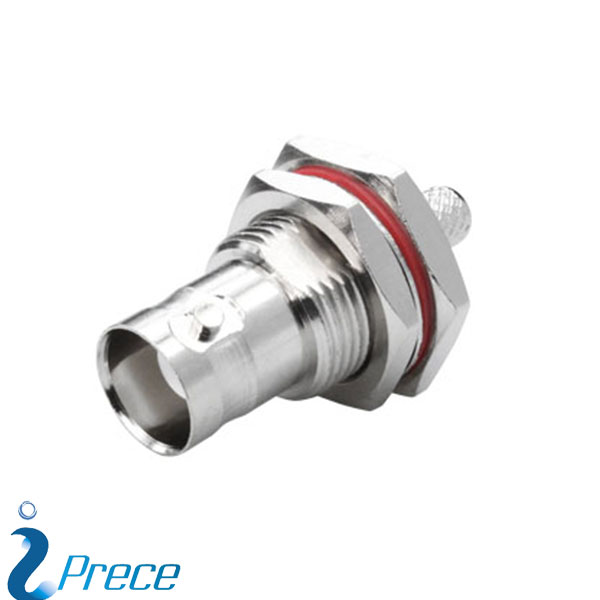
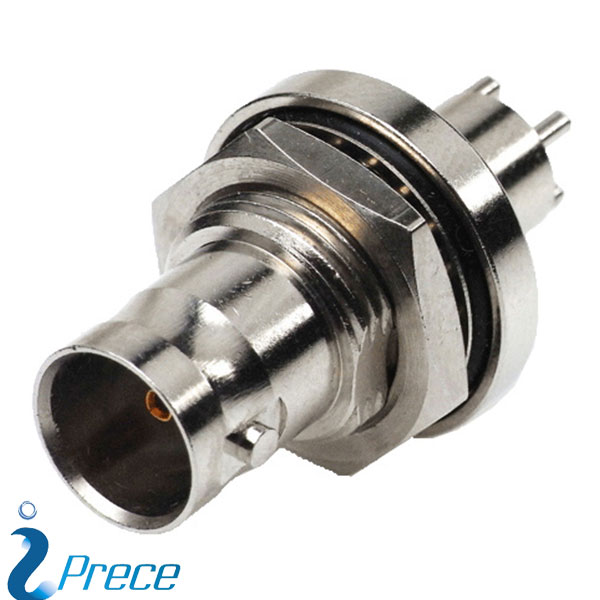
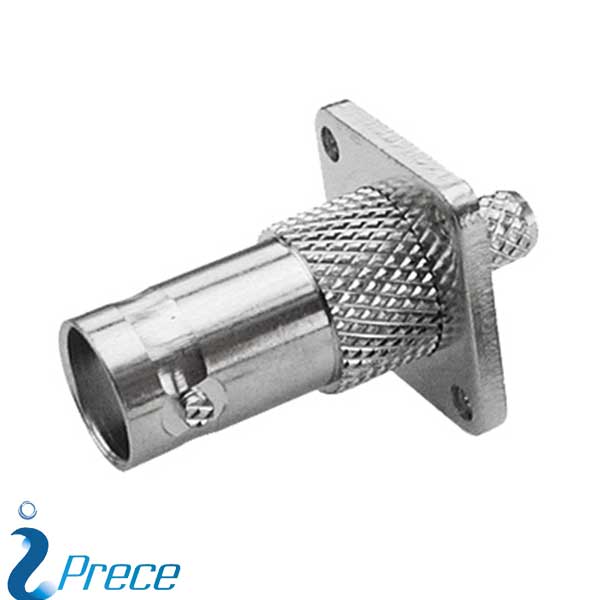
- Multiple Mounting Styles – Crimp, solder, PCB mount, right-angle, bulkhead.
- High Durability – Designed for 500+ mating cycles without performance loss.
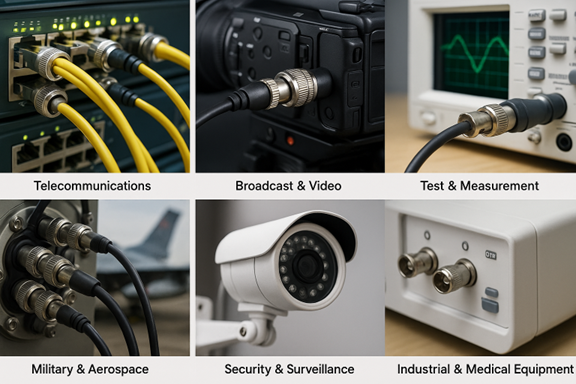
Applications of BNC Connectors
- Telecommunications – RF signal transmission and network infrastructure.
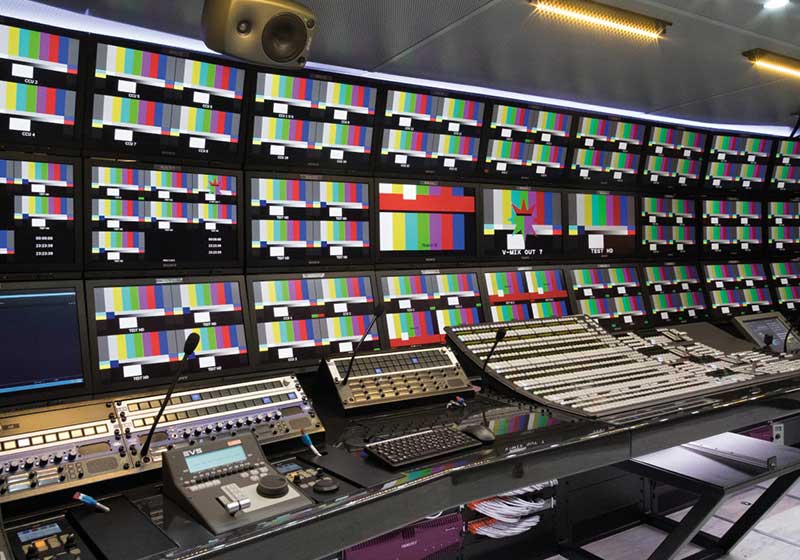
- Broadcast & Video – 75 Ω BNC connectors for HDTV, SDI, CCTV systems.
- Test & Measurement – Used in oscilloscopes, spectrum analyzers, generators.
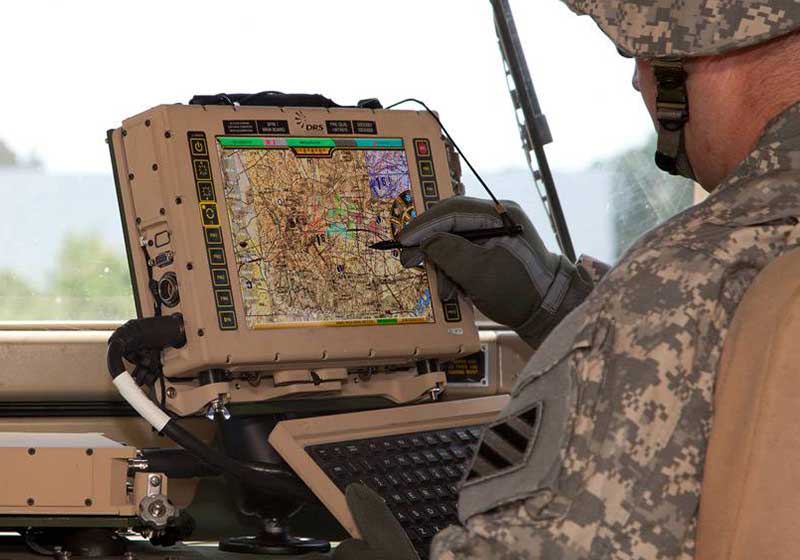
- Military & Aerospace – Reliable interconnects for mission-critical RF systems.
- Security & Surveillance – CCTV cameras, DVRs, monitoring networks.
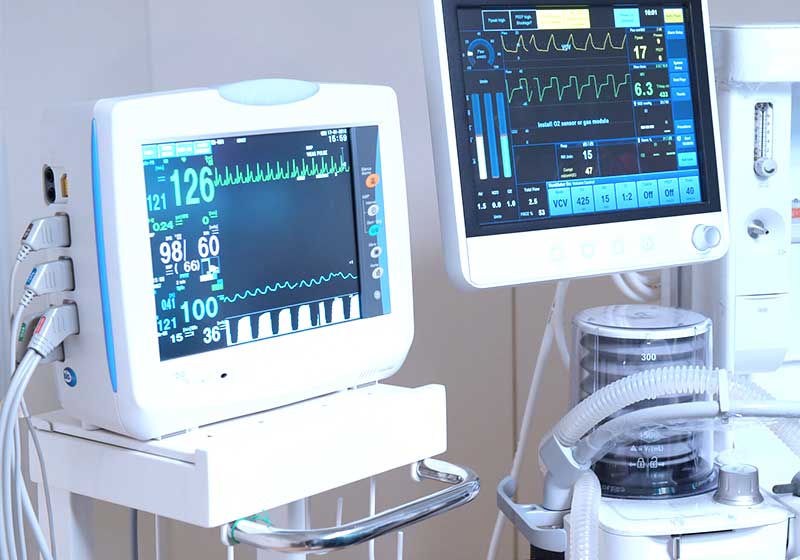
- Medical & Industrial Equipment – Signal integrity for sensitive devices.
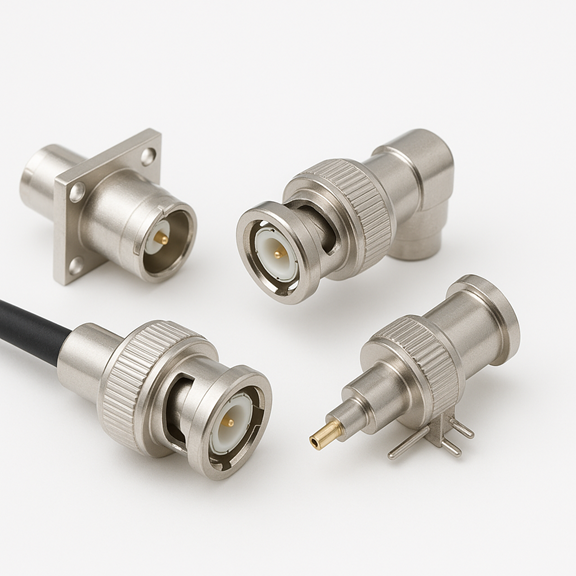
Technical Specifications
- Impedance: 50 Ω or 75 Ω
- Frequency Range: DC – 4 GHz (HD-BNC up to 10 GHz)
- Voltage Rating: ~500 V peak
- Coupling Mechanism: Bayonet, quarter-turn lock
- Contact Material: Brass/Beryllium copper, gold-plated
- Body Material: Brass/Stainless steel with nickel plating
- Cable Compatibility: RG-58, RG-59, RG-179, and others
- Durability: Rated for 500+ mating cycles
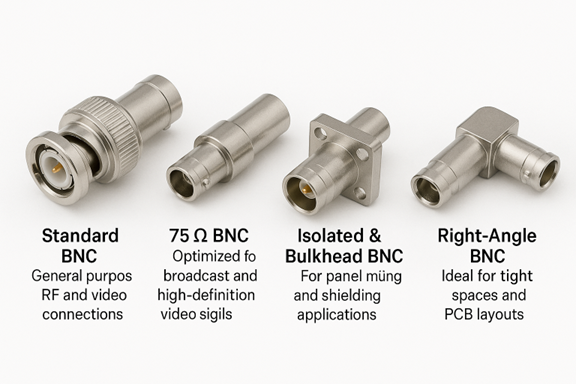
Types of BNC Connectors
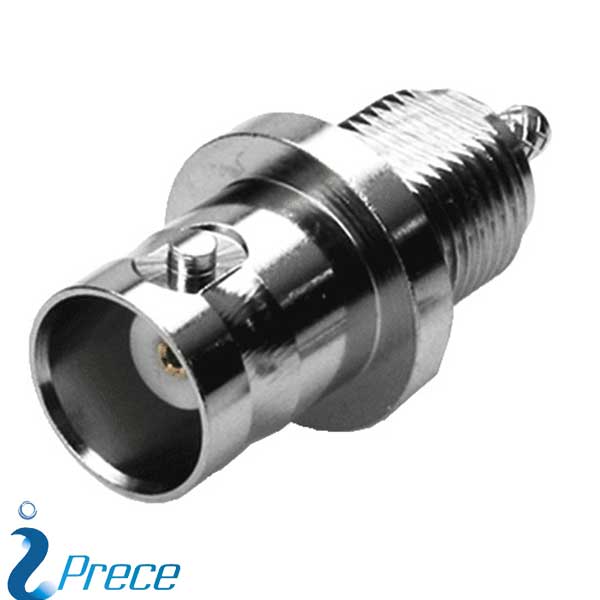
- Standard BNC – General RF and video use.
- 75 Ω BNC – Optimized for broadcast & video.
- Mini BNC & HD-BNC – Compact size for high-density boards.
- Isolated & Bulkhead BNC – Panel mount and shielding options.
- Right-Angle BNC – Space-saving for PCB mounting.
History and Evolution of BNC Connectors
The BNC connector was originally developed in the 1940s by Paul Neill and Carl Concelman. Since then, it has become a global standard in RF and video transmission. Its design has evolved into high-density versions such as HD-BNC, and compact Mini-BNC formats to meet the growing demand for higher frequencies and smaller equipment designs.
Comparison with Other RF Connectors
While BNC connectors are versatile, they are often compared with SMA, N, and TNC connectors. SMA connectors provide superior performance at higher frequencies, N connectors offer low-loss connections for microwave applications, and TNC connectors deliver threaded coupling for improved vibration resistance. However, BNC remains unmatched for its ease of use, quick connection, and versatility across industries.
Maintenance & Testing of BNC Connectors
To maintain optimal performance, BNC connectors should be inspected regularly for wear and cleaned with proper RF contact cleaners. In high-frequency applications, regular VSWR and insertion loss testing is recommended. Proper handling and correct torque application can extend connector lifespan significantly.
Why Choose iPrece BNC Connectors?
At iPrece, we deliver a wide range of high-quality BNC connectors with international quality standards. Our connectors are designed for performance, durability, and cost-efficiency. With over three decades of expertise in RF and microwave solutions, we provide strict quality assurance, global sourcing, and competitive pricing tailored for OEMs, integrators, and distributors.
Related Products
- SMA Connectors – https://iprece.com/product-category/rf-connectors/sma-connectors/
- N Connectors – https://iprece.com/product-category/rf-connectors/n-connectors/
- TNC Connectors – https://iprece.com/product-category/rf-connectors/tnc-connectors/
FAQs about BNC Connectors
- Q: What is the difference between 50 Ω and 75 Ω BNC connectors?
A: 50 Ω is used in RF, telecom, and test equipment, while 75 Ω is mainly used in broadcast and video.
- Q: Can BNC connectors handle high-frequency signals?
A: Yes, standard BNC supports up to 4 GHz, and HD-BNC versions extend to 10 GHz.
- Q: Are BNC connectors suitable for outdoor applications?
A: Yes, with weatherproof and stainless steel versions, they can be used in outdoor RF and video systems.
- Q: What are the advantages of BNC over SMA connectors?
A: BNC offers faster connection/disconnection and is ideal for quick test setups, while SMA is preferred for higher frequency precision.