

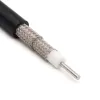


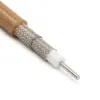

RG cables structural design and signal integrity
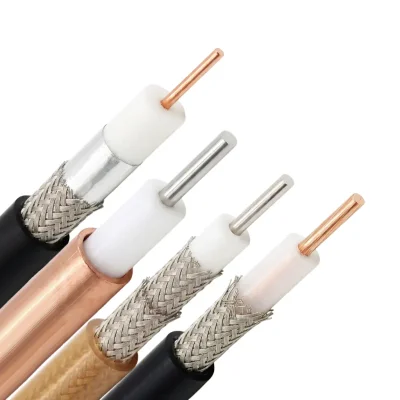
The RG coaxial cable series minimizes insertion loss across long transmission lines. Solid center conductors provide phase stability for test instruments. Stranded configurations ensure mechanical flexibility for dynamic routing requirements.
Core dielectrics include PE, foam PE (F), and solid PTFE. These materials establish signal propagation velocities between 65.9% and 85%. This architecture controls signal delay and reduces internal power dissipation.
Coaxial RG cables utilize outer shields ranging from single copper to triple-shielded matrices. Multiple conductive layers prevent electromagnetic interference in dense server racks. This maintains signal isolation across sensitive aerospace and military enclosures. These shielding structures ensure strict MIL-STD compliance for defense systems.
Outer jackets feature standard PVC, PVC (NC), and FEP. Non-contaminating PVC (NC) jackets prevent plasticizer migration into the dielectric core. This chemical stability extends the physical lifespan of the cable.
PTFE cores and extruded FEP jackets support high-temperature environments. These RG cables operate continuously up to 200 °C. Jacket diameters range from 2.54 mm to 10.29 mm.
RG coaxial cable specifications
Compare RG cable types specifications across three tables: electrical, mechanical, and material & environmental.
RG RF cables electrical specifications
Generic Family | Impedance | VoP | Attenuation @ 1 GHz | Max Power @ 1 GHz | Max Frequency | No. of Shields |
RG402 | 50 Ω | 69.5 % | 36.42 dB/100 m | 450 W | 34 GHz | 1 |
RG405 Tinned | 50 Ω | N/A | 72.18 dB/100 m | N/A | 40 GHz | 1 |
RG58 | 50 Ω | 65.9 % | 65.62 dB/100 m | 44 W | 5 GHz | 1 |
RG8 | 50 Ω | 66.0 % | 26.25 dB/100 m | 190 W | 1 GHz | 1 |
RG59 | 75 Ω | 66.0 % | 37.73 dB/100 m | 77 W | 1 GHz | 1 |
RG6-CATV | 75 Ω | 85.0 % | 21.49 dB/100 m | 6.5 W | 3 GHz | 3 |
RG142 | 50 Ω | 70.0 % | 42.32 dB/100 m | N/A | 8 GHz | 2 |
RG316 | 50 Ω | 69.0 % | 124.67 dB/100 m | N/A | 3 GHz | 1 |
RG393 | 50 Ω | 69.5 % | 24.61 dB/100 m | 1700 W | 10 GHz | 2 |
RG400 | 50 Ω | 70.0 % | 48.23 dB/100 m | 600 W | 12.4 GHz | 2 |
RG coax cables mechanical specifications
Generic Family | Flex Type | Center Conductor | Strands | Min Bend Radius (One Time) | Min Bend Radius (Repeated) | Jacket Diameter |
RG402 | Semi-Rigid | Solid | 1 | N/A | 6.35 mm | N/A |
RG405 Tinned | Semi-Rigid | Solid | 1 | 1.27 mm | N/A | N/A |
RG58 | Flexible | Stranded | 19 | 24.89 mm | 49.78 mm | 4.95 mm |
RG8 | Flexible | Stranded | 7 | N/A | N/A | 10.29 mm |
RG59 | Flexible | Solid | 1 | N/A | N/A | 6.15 mm |
RG6-CATV | Flexible | Solid | 1 | N/A | 35.05 mm | 7.06 mm |
RG142 | Flexible | Solid | 1 | N/A | 25.40 mm | 4.95 mm |
RG316 | Flexible | Stranded | 7 | N/A | N/A | 2.59 mm |
RG393 | Flexible | Stranded | 7 | N/A | 99.06 mm | 9.91 mm |
RG400 | Flexible | Stranded | 19 | N/A | 25.40 mm | 4.95 mm |
Coaxial RG cables material & environmental specifications
Generic Family | Dielectric Material | Outer Jacket Material | Max Operating Temp | Coax Type |
RG402 | PTFE | Copper (No Jacket) | 125 °C | Coax |
RG405 Tinned | PTFE | Tinned Copper (No Jacket) | 125 °C | Coax |
RG58 | PE | PVC (NC) | 80 °C | Coax |
RG8 | PE | PVC (NC) | 80 °C | Coax |
RG59 | PE | PVC (NC) | 70 °C | Coax |
RG6-CATV | PE (F) | PVC (NC) | 80 °C | Coax |
RG142 | PTFE | FEP | 200 °C | Coax |
RG316 | PTFE | FEP | 200 °C | Coax |
RG393 | PTFE | FEP | 200 °C | Coax |
RG400 | PTFE | FEP | 200 °C | Coax |