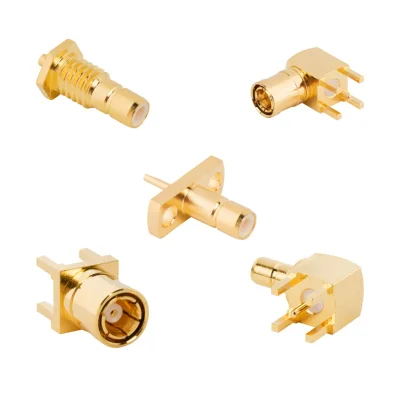

RF SMB Connector

RF SMB connectors are 50 Ω snap-on interconnects supporting broadband frequencies from DC to 4 GHz. Extended-range configurations operate up to 10 GHz for high-density system integration under MIL-STD-348 standards.

Coupling MechanismSnap-On
Mating Cycles (Min)500
Max frequency4 GHz (10 GHz Ext.)
Impedance50 Ω
  • Low mating force mechanism
  • PTFE insulation standard
  • MIL-STD-348 compliant
  • Vibration resistant (15 G)
Fast Production🏭 OEM Direct🛡️ 100% VNA Tested
166 Products Found
Part / Descriptionfrequency-maxbody-materialcontact-finishoperating-temp-minoperating-temp-maxportsActions
4 GHzBrassGold-65 °C C165 °C C1 (Single Port)
Details
4 GHzBrassGold-65 °C C165 °C C1 (Single Port)
Details
4 GHzBrassGold-65 °C C165 °C C1 (Single Port)
Details
4 GHzBrassGold-65 °C C165 °C C1 (Single Port)
Details
4 GHzBrassGold-65 °C C165 °C C1 (Single Port)
Details
4 GHzBrassGold-65 °C C165 °C C1 (Single Port)
Details
3 GHzBrassGold-65 °C C165 °C C1 (Single Port)
Details
3 GHzBrassGold-65 °C C165 °C C1 (Single Port)
Details
4 GHzBrassGold-65 °C C165 °C C1 (Single Port)
Details
4 GHzBrassGold-65 °C C165 °C C1 (Single Port)
Details

Target Applications & Industries

Wireless infrastructure

Base station modules

Instrumentation

Test equipment

Broadcast systems

Telemetry platforms

GPS and data-communications

SMB coax connectors: high-density architecture

The RF SMB connector series integrates a subminiature form factor with a snap-on coupling mechanism. This design enables rapid mating in space-constrained architectures where standard threaded interfaces become impractical.

The housings of these SMB coax connectors are manufactured from Brass, Zinc Diecast, Zamac, or Beryllium Copper. This ensures mechanical stability and reliable RF shielding. For the center contacts, Beryllium Copper or Brass is utilized with Gold plating to actively combat corrosion.

Engineers can specify Gold, Nickel, Bright Tin, or White Bronze body plating to match specific environmental requirements. Internally, PTFE dielectric insulators consistently maintain a stable 50 Ω impedance.

SMB RF connector specifications

Review the exact electrical parameters, material compositions, and environmental ratings for SMB series interconnects.

SMB coaxial connector electrical specifications

Parameter

Specification

Impedance

50 Ω

Frequency Range

DC to 4 GHz (DC to 10 GHz on Extended Range)

Voltage Rating

335 VRMS Continuous

Dielectric Withstanding Voltage

1000 VRMS Max

VSWR (Straight, RG178/196)

1.30 + 0.04 f (GHz)

VSWR (Right Angle, RG178/196)

1.45 + 0.06 f (GHz)

VSWR (Straight, RG174/316/188)

1.25 + 0.04 f (GHz)

VSWR (Right Angle, RG174/316/188)

1.35 + 0.04 f (GHz)

Insulation Resistance

1000 MΩ Min

Center Contact Resistance

6 mΩ Max

Outer Contact Resistance

1 mΩ Max

RF Leakage

-120 dB Max (DC to 3 GHz)

Insertion Loss (Straight)

0.30 dB @ 1.5 GHz Max

Insertion Loss (Right Angle)

0.60 dB @ 1.5 GHz Max

Power Handling

95 W @ 1 GHz @ 25 °C

RF SMB connector mechanical specifications

Parameter

Specification

Mating Cycles

500 Min

Coupling Mechanism

Snap-On

Interface Specification

MIL-STD-348

Engagement Force

14 lbs (62 N) Max

Disengagement Force

2 lbs (8.9 N) Max

Coupling Torque

Not Applicable (Snap-On)

SMB series material specifications

Parameter

Specification

Body Material

Brass, Zinc Diecast, Zamac, Beryllium Copper

Body Plating

Gold, Nickel, Bright Tin, White Bronze, Tin

Center Contact Material

Brass, Beryllium Copper

Center Contact Plating

Gold

Insulator

PTFE

SMB RF connector environmental specs & compliance

Parameter

Specification

Temperature Range

-65 °C to +165 °C

Thermal Shock

MIL-STD-202 Method 107 (Condition B), except high temp @ +200 °C

Corrosion (Salt Spray)

MIL-STD-202 Method 101 (Condition B) 5% Salt Solution

Vibration

MIL-STD-202 Method 204, snap-on (Condition B) 15 G

Mechanical Shock

MIL-STD-202 Method 213, snap-on (Condition B) 75 G @ 6 ms 1/2 sine

Moisture Resistance

MIL-STD-202 Method 106

Altitude

MIL-STD-202 Method 105 (Condition C)

IP Rating

IP68 (variant dependent)

RF SMB Connector FAQs

What is the advantage of the SMB snap-on coupling over threaded SMA connectors?
The snap-on mechanism accelerates installation by enabling rapid mating and demating in dense assembly environments. Requiring a maximum engagement force of 14 lbs (62 N), this design eliminates torque wrenches entirely. Engineers can expect reliable performance across a minimum of 500 mating cycles.
How does the VSWR differ between straight and right-angle SMB configurations?
Right-angle configurations introduce a minor impedance disruption. This is due to the 90-degree internal bend. For RG174 cables, straight SMB variants yield a VSWR of 1.25 + 0.04 f (GHz). Right-angle variants provide 1.35 + 0.04 f (GHz).
What body plating options are available?
Plating options include Gold, Nickel, Bright Tin, and White Bronze. Gold provides oxidation resistance and solderability. Nickel provides high durability and wear resistance. White Bronze is used in non-magnetic applications.
What is the maximum power handling and environmental endurance of the SMB RF connector series?
SMB coax connectors manage up to 95 W of power at 1 GHz operating at 25 °C. Thermal stability spans from -65 °C to +165 °C. They successfully endure 15 G vibration and 75 G mechanical shock strictly following MIL-STD-202 specifications.
Do SMB connectors provide IP-rated environmental sealing?
The standard RF SMB connector is not IP-rated by default. However, specialized configurations are engineered to meet strict IP68 standards for dust and moisture protection. Engineers must specify exact part numbers, such as the 903-841J-51S, to ensure sealed performance.