Coaxial Cable Color Meaning: Is There a Standard Color Code?

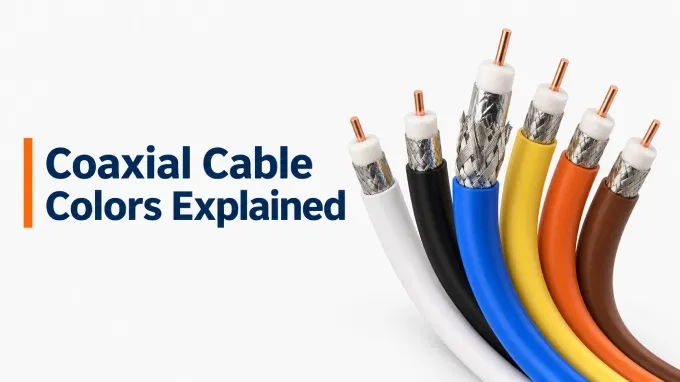
When it comes to coaxial cable colors, you will find a wide variety of options, including but not limited to:
White
Black
Orange
Blue
Brown
Yellow
However, the coaxial cables’ outer jackets do not follow a universal color code. Although coax cables can be color coded within a defined product range, installation, or specification. The jacket is the protective outer covering over the shield, separate from the dielectric insulation inside the cable.
Generally, coax cable colors serve three purposes:
Appearance: A color may help the cable blend with its surroundings or match an equipment design.
Manufacturer identification: A supplier may include a color code in its part numbers to identify the selected jacket option.
Installation identification: A documented scheme may assign colors to different cable runs, signal paths, or channels.
Some specialist specifications prescribe jacket colors. ESCC 3902/002, for example, assigns colors to particular coaxial cable variants. Those assignments apply within that specification’s scope; they do not establish a general color code for other coaxial cables.
What Can Different Coax Cable Colors Mean?
Different coaxial cable colors may help a cable blend into its surroundings, identify a cable family, or distinguish connections. The following examples describe common uses; practices vary among manufacturers, operators, and installations.
White Coaxial Cable
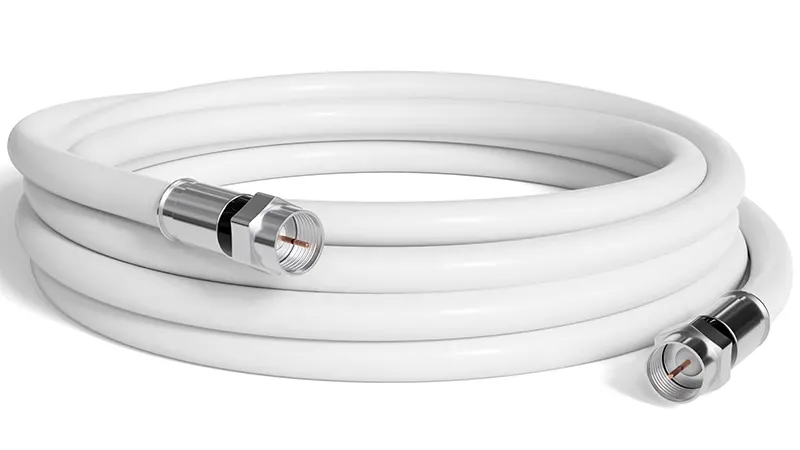
White coaxial cable is often chosen to blend with light walls, skirting, and other interior finishes. White RG-6 is a familiar example in TV and satellite installations, particularly where the cable remains visible between a wall outlet and connected equipment. White jackets also appear on other cable types, including broadcast video coax. The color is an appearance option across several applications; it does not, by itself, identify a particular cable type or restrict the cable to indoor use.
Black Coaxial Cable
Black coaxial cable is widely used for residential installations, equipment wiring, and outdoor antenna runs. Many outdoor RF cables have a black polyethylene (PE) jacket. In outdoor applications, carbon black is typically added to the jacket material to provide excellent UV (sunlight) resistance. Black cables are also available with fire-retardant jackets for indoor building installations or water-blocking constructions for underground use. These products can look identical despite having vastly different installation requirements. A black jacket alone does not confirm sunlight resistance, weather resistance, or suitability for direct burial; those properties depend on the cable’s exact construction and specified ratings.
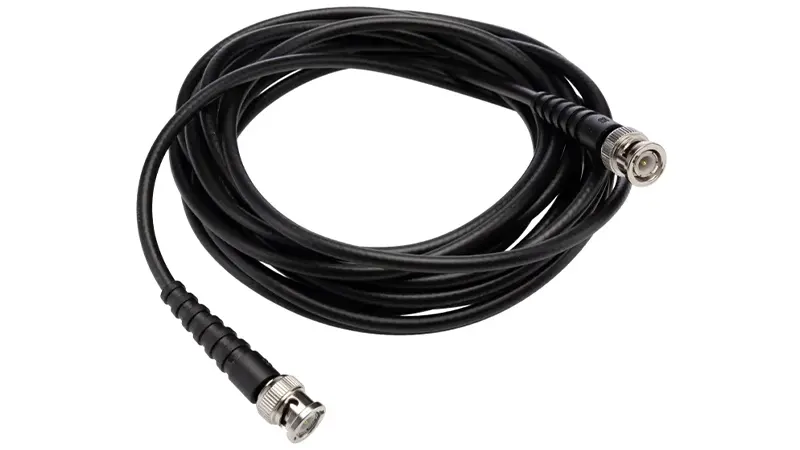
Blue Coaxial Cable
Blue coaxial cable can help distinguish cable runs, channels, or options within a manufacturer’s product range. Blue-jacketed 75 Ω coax, for example, is available for serial digital interface (SDI) video connections. An installation may assign blue to a particular signal path or group of channels. That meaning comes from the documented identification scheme; blue does not designate a universal impedance or a “low-loss” or “high-frequency” performance grade.
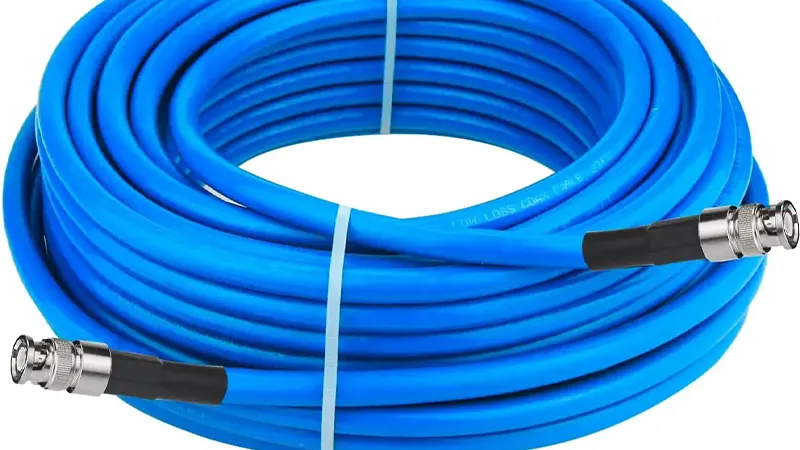
Yellow Coaxial Cable
Yellow coaxial cable can make a connection easier to distinguish within a bundle or equipment rack. Yellow jackets are available on 75 Ω video coax and may identify particular channels or cable runs under an installation’s color scheme. This should be distinguished from a cable that simply has a yellow RCA plug. The plug’s identifying color follows the connector conventions discussed in the next section.
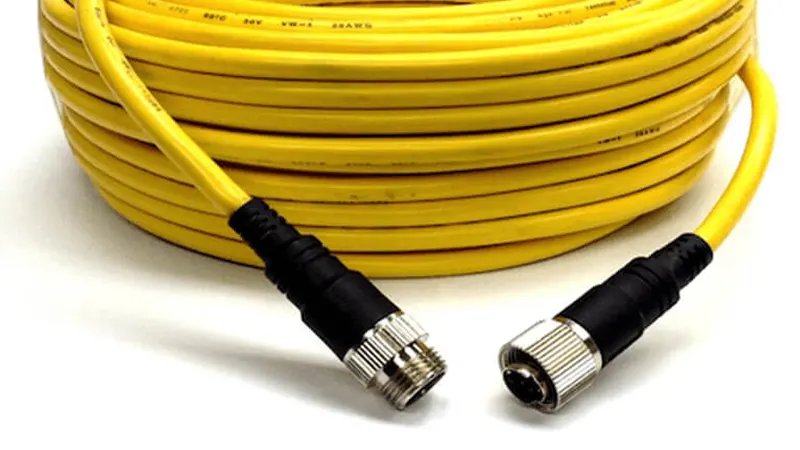
Coaxial Cable Orange
Orange coaxial cable is often used for outdoor service connections where its bright jacket improves visibility and safety. Orange RG-6 products are available with constructions specifically designed for direct burial—often featuring a water-blocking gel compound (flooded cable)—so this color is frequently encountered on underground runs or near service entry points.
Some operators also use orange for temporary lines laid above ground while permanent underground work is pending. A temporary connection may still use a cable designed for burial. Whether a run is temporary and whether its cable can actually be buried are separate questions: one concerns how the connection is being used, while the other concerns the cable’s construction and environmental specifications. Orange alone does not establish either.
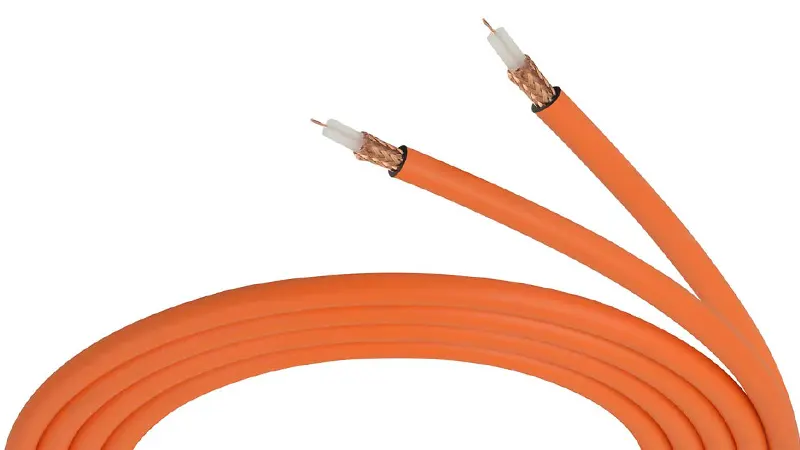
Brown Coaxial Cable
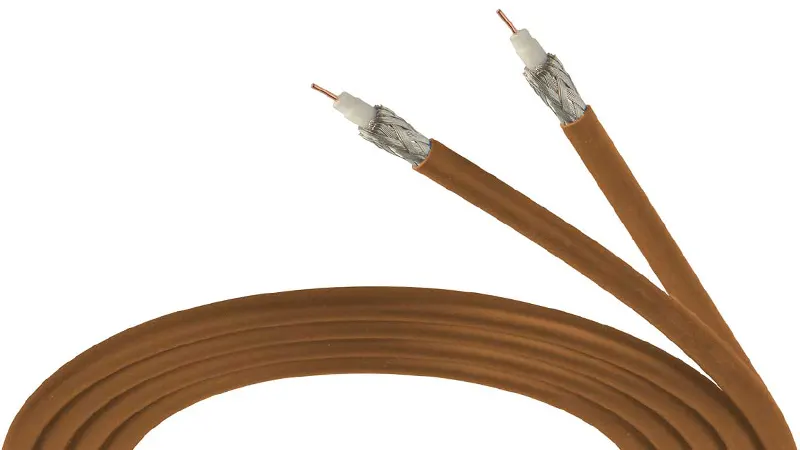
Brown coaxial cable appears in both RF equipment and video installations, where similar colors can accompany different constructions. RG-316 RF cable, for example, is available with a brown fluorinated ethylene propylene (FEP) jacket and a nominal impedance of 50 Ω.
The tan or brown appearance familiar on some fluoropolymer-jacketed RF cables is therefore only one context in which this color occurs. Ultimately, as with most coaxial cable colors, brown alone does not identify the jacket material, impedance, or intended application.
Are Jacket Colors the Same as RCA Plug Colors?
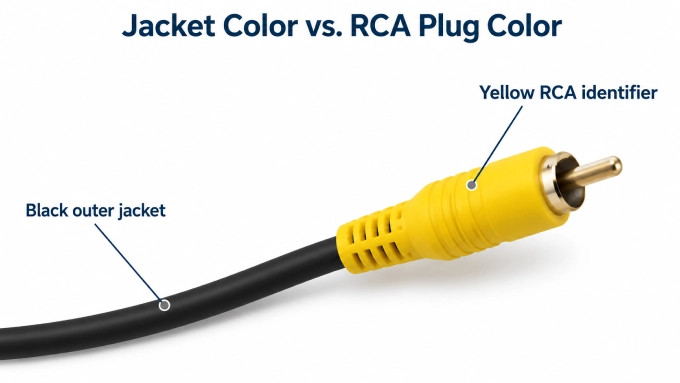
No. RCA plug and socket colors commonly identify the signal or channel associated with a connection. That convention applies to the connector or equipment port, independently of the cable’s outer-jacket color.
Plug or port color | Common intended function |
Yellow | Composite video |
Orange | Coaxial digital audio, commonly S/PDIF |
White / red | Left / right analog audio |
Green / blue / red | Component video: Y / Pb / Pr |
RCA describes a connector format that can be fitted to cables with different constructions. Neither the plug’s color nor its shape confirms the cable’s impedance, shielding, or usable frequency range. Use the equipment’s port labels to identify the connection’s function and the cable documentation to verify suitability. If the colors and labels disagree, follow the equipment documentation.
How Can You Identify or Replace Coax Without Relying on Color?
Identify coax through its markings and product documentation, then check whether a replacement meets the signal and installation requirements. Ultimately, a coax cable color is not an RF performance specification.
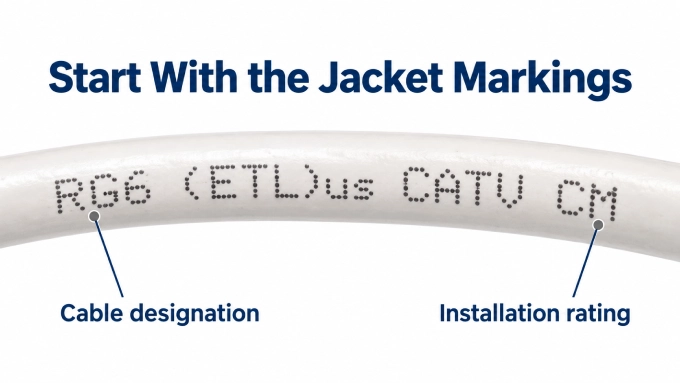
Read the jacket markings. Record the manufacturer, complete part number, cable designation, and printed ratings. Include any suffixes or color codes in the part number, because they may distinguish jacket materials or installation variants within the same cable family.
Check installation suitability. Verify the jacket material and the applicable sunlight, moisture, direct-burial, and building installation ratings. These describe separate properties: sunlight resistance, for example, does not establish burial suitability. Different coax cable colors within a product family may also have different environmental specifications, including restrictions on outdoor or aerial use.
Check installation suitability. Verify the jacket material and the applicable sunlight, moisture, direct-burial, and building installation ratings. These describe separate properties: sunlight resistance, for example, does not establish burial suitability. Different color variants within a product family may also have different environmental specifications, including restrictions on outdoor or aerial use.
Compare the complete replacement assembly. Match its length, connectors, electrical specifications, and installation suitability to the actual requirements. Confirm mechanical fit, including cable diameter and bend-radius limits where relevant. A matching cable designation is only one part of this comparison.
For example, a black 75 Ω RG-6 assembly can replace a white 75 Ω RG-6 assembly when its connectors, attenuation over the required length, and installation ratings meet the application’s requirements. Matching the RG-6 designation and impedance alone is insufficient, which reinforces the core rule that coaxial cable colors are just an outer feature, not a technical performance specification.
FAQ
Discussion (0)
Be the first to comment.