SMB to SMB Cable Assembly

Configure an SMB to SMB cable assembly by gender, body style, cable family, and length. Choose straight, right-angle, and bulkhead options for compact 50 Ω interconnects up to 4 GHz.
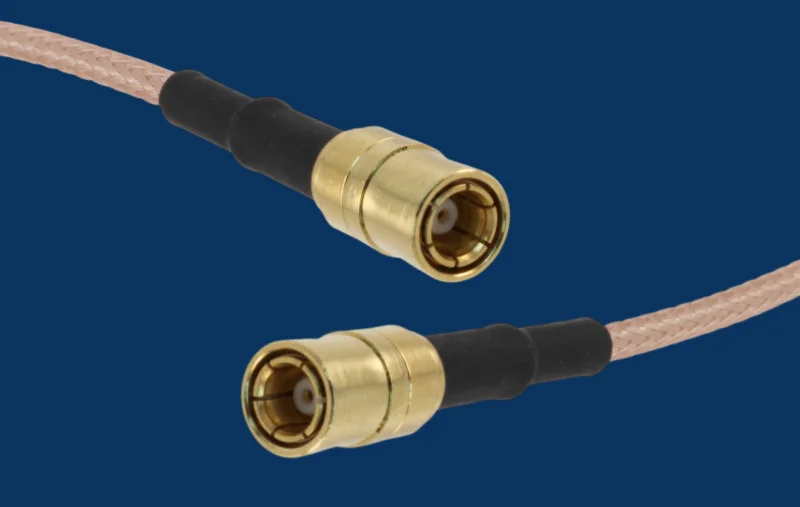
SMB to SMB Cable
✓Exact-Match Configurations
✓VNA Test Reports Provided
✓Pre-Production Design Review

Request SMB to SMB Cable Assembly Quotes

Submit your custom RF requirements for a verified technical review and formal wholesale pricing within 24 hours.

How would you like to specify your requirements?

Quick List / Upload

Paste your requirements or upload a BOM.

Configure Assembly

Select connectors & cable type step-by-step.

Click to upload Drawing / BOM
PDF, XLSX, CSV, DWG up to 25MB

SMB to SMB Cable Configurations

Select the end combination that matches your equipment interfaces. Then, configure the cable and length using our custom RF cable assemblies tool.

01

SMB Female to SMB Female Cable

Connect two male SMB interfaces in instruments, modules, and RF test systems. Straight and right-angle ends support both direct connections and space-constrained routing.

Configure →
02

SMB Male to SMB Female Cable

Extend an existing SMB connection or bridge equipment with opposite interface genders. This configuration can relocate antennas, modules, or instrument connections without adding a separate adapter.

Configure →
03

SMB Male to SMB Male Cable

Connect two female SMB ports with a compact snap-on RF link. Choose straight or right-angle ends to suit equipment access and the available routing space.

Configure →

SMB to SMB Technical Overview

Review the technical parameters below to select the right cable family for your build.

Interface overview
Impedance50 Ω
Frequency rangeDC – 4 GHz
Gender combinationsMale–male, male–female, female–female
Body stylesStraight, right-angle
CouplingSnap-on
MountingIn-line, bulkhead
Supported Coaxial Cables
CableBest forFlexibilityLossImpedance
Flexible miniature coaxCompact internal RF routingHighModerate50 Ω
Low-loss flexible coaxLonger connections with tighter loss budgetsMedium–highLow50 Ω
Double-shielded flexible coaxTest equipment and interference-sensitive systemsMediumLow–moderate50 Ω
Hand-formable coaxCompact routes that must retain their shapeMediumLow50 Ω
Semi-rigid coaxFixed routing with strong shieldingLowLow50 Ω

Final compatibility and performance are confirmed during engineering review.

Configured for Your RF System

The right SMB to SMB cable assembly keeps the RF path compact without forcing compromises in routing, loss, or serviceability.

01
Tool-free snap-on mating

Connect and disconnect equipment quickly without a torque wrench or coupling nut.

02
50 Ω performance up to 4 GHz

Match the cable combination to the operating band, VSWR target, and insertion-loss budget.

03
More control in confined spaces

Straight and right-angle ends help route coax near closely spaced boards, modules, and enclosure walls.

04
Built around the actual interfaces

Select the end combination, mounting style, cable, and length without introducing avoidable adapters.

SMB to SMB Cable Applications

An SMB assembly suits RF systems where compact dimensions and quick access matter alongside controlled electrical performance.

RF test and measurement

Connect switch matrices, signal modules, instruments, and test fixtures.

GPS and navigation equipment

Route antenna signals between compact receivers and internal RF modules.

Wireless and telecommunications systems

Interconnect filters, amplifiers, receivers, and radio modules in dense equipment.

Industrial and medical electronics

Carry RF and measurement signals inside compact monitoring, diagnostic, and control equipment.

What Is an SMB to SMB Cable Assembly?

An SMB to SMB cable assembly is a coaxial cable terminated with an SMB interface at both ends. This creates a compact 50 Ω interconnect for RF modules, instruments, and internal wiring.

Its snap-on coupling mates without a wrench, while straight, right-angle, and bulkhead ends accommodate different layouts. The complete connector and cable combination determines the usable frequency, insertion loss, bend radius, and environmental limits.

SMB to SMB Coaxial Cable Specifications

Standard SMB to SMB assembly operates in 50 Ω systems, but its full 4 GHz capability is not automatic. Cable construction, connector geometry, length, and end orientation all influence the final RF performance.

Electrical Specifications

Parameter

Typical range or options

Qualification

Impedance

50 Ω

Connector and cable must match

Frequency range

DC–4 GHz

Some builds are limited to 1 or 3 GHz

Return loss

≥17 dB typical

Depends on frequency and configuration

Insertion loss

Assembly-specific

Increases with frequency and length

Shielding

Single, double, or solid outer conductor

Determined by cable construction

Power handling

Assembly-specific

Derated by frequency and temperature

Mechanical and Environmental Specifications

Parameter

Typical range or options

Interfaces

SMB assembly plug or jack

Center contacts

Pin or socket

Polarity

Standard; reverse polarity where specified

Body styles

Straight, right-angle

Mounting

In-line, bulkhead

Cable construction

Flexible, low-loss, hand-formable, semi-rigid

Cable diameter

Approximately 2.2–5.4 mm

Cable length

Standard or custom

Jacket materials

FEP, PTFE, PVC

Materials

Brass and beryllium copper

Contact plating

Gold

Operating temperature

Typically −55 °C to +125 °C

Mating durability

Typically 500 cycles

Environmental sealing

Standard unsealed; sealed bulkheads where rated

Testing, Inspection and Documentation

A successful snap-on connection does not confirm the termination quality of an SMB to SMB cable assembly. Testing and inspection are matched to its application, operating band, and qualification requirements.

  • Electrical integrity: Continuity, open/short, and Hi-Pot testing identify conductor, insulation, and termination faults.

  • RF performance: VNA testing can verify VSWR or return loss and insertion loss across the specified frequency range.

  • Mechanical inspection: Visual, dimensional, and pull checks assess connector alignment, contact position, crimp quality, and cable retention.

  • Documentation: Lot traceability, serialized identification, and test reports can be specified for qualification and production orders.

BEFORE YOU REQUEST A QUOTE

SMB to SMB Cable Assembly FAQs

Does every SMB to SMB cable assembly operate up to 4 GHz?

No. Although 4 GHz is a common upper limit for the SMB interface, the complete assembly may be rated only to 1 or 3 GHz. Cable type, connector construction, body style, and termination quality all affect the usable frequency range.

How does length affect loss in an SMB to SMB coaxial cable?

Insertion loss increases with both cable length and signal frequency. A longer assembly therefore delivers less signal power at the receiving end. For loss-sensitive systems, use the shortest practical route and specify the maximum insertion loss at the actual cable length and operating frequency.

Should I choose RG174 or RG316 for an SMB to SMB assembly?

RG174 is commonly used for economical, flexible routing in compact indoor equipment. RG316 uses temperature-resistant PTFE and FEP materials and is often selected for harsher operating conditions. Neither cable should be assumed to have lower loss without comparison.

How is the length of an SMB to SMB assembly measured?

Assembly length is defined on a dimensioned drawing. It may refer to the mating planes, end faces, or cable between bodies. Right-angle and bulkhead connectors make this distinction important.

Can an SMB to SMB cable assembly be used outdoors or in high-vibration equipment?

Only when the complete assembly is designed for those conditions. Standard snap-on SMB connections are not automatically sealed or vibration-resistant. Outdoor installations require an appropriate jacket and explicitly rated sealing, while vibration-prone equipment may need added strain relief, retention, or a more secure connector system.

SUBMIT REQUIREMENT
Configure Your Assembly or Upload Existing BOM

Select your specifications online or upload complete drawings for engineering review.