Network Analyzer (VNA) vs Spectrum Analyzer

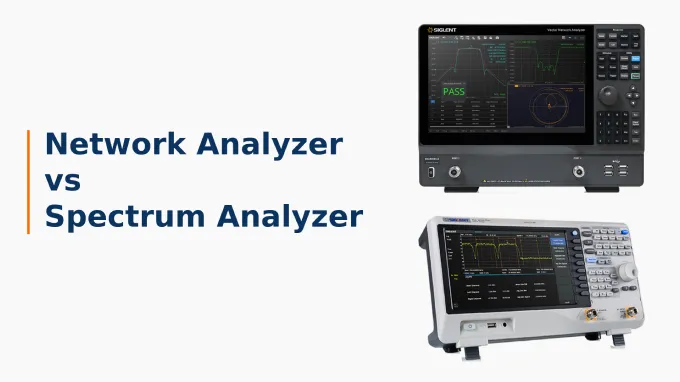
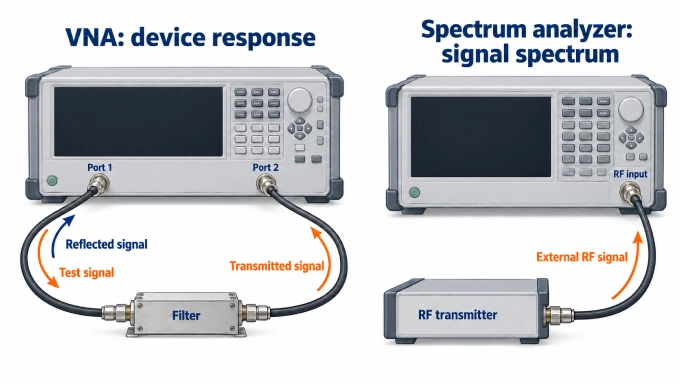
A network analyzer applies a controlled test signal to the device under test (DUT), usually sweeping through a frequency range. The reflected and transmitted signals are measured relative to the incident signal. These ratios are reported as scattering parameters, or S-parameters.
A swept spectrum analyzer tunes its receiver across a selected frequency span, measuring the power within a narrow band at each position. FFT-based analysis calculates a spectrum from digitized samples. Both methods produce a plot of signal level against frequency.
Note that “network analyzer” is the broader category:
A vector network analyzer (VNA) measures magnitude and phase.
A scalar network analyzer measures magnitude only.
The comparison below focuses on VNAs. A vector signal analyzer (VSA) analyzes signal magnitude, phase, and modulation using I/Q data; this is a different measurement function from vector network analysis.
Comparison | VNA | Spectrum analyzer |
Primary question | How does the DUT reflect and transmit a signal? | Which frequency components are present, and at what levels? |
Operating principle | Compares the DUT’s response with a reference. | Resolves input signals by frequency and measures their levels. |
Test signal source | Uses a controlled source within the instrument. | Receives an external signal; a tracking generator can supply a test stimulus. |
Results displayed | S-parameter magnitude in dB and, for a VNA, phase in degrees. | Signal power versus frequency, typically in dBm. |
Phase information | A VNA measures the DUT’s phase response. | An ordinary power spectrum omits phase. Vector signal analysis (VSA) separately characterizes signal phase and modulation. |
Typical connections | One test port for reflection; two for transmission. | An RF input connected to a signal output or receiving antenna. |
Vector Network Analyzer vs Spectrum Analyzer: What Do They Measure?
A VNA measures how an RF device affects an applied signal. A spectrum analyzer measures how a signal’s power is distributed across frequency.
What Does a Network Analyzer Measure?
Reflection coefficients, S11 and S22: S11 and S22 describe input and output reflection, respectively, with the opposite port matched. Their magnitudes determine return loss and VSWR.
Complex impedance: Reflection magnitude and phase determine resistance and reactance at the reference plane. A VNA uses small-signal S22 to measure RF amplifier output impedance at a specified bias, with the amplifier’s input matched.
Transmission coefficients, S21 and S12: S21 describes forward gain or insertion loss, while S12 describes reverse transmission or isolation. Their magnitudes are reported in dB. For custom RF cable assemblies, the result includes the cable and connectors.
Transmission phase: A VNA measures the phase shift through the DUT at each frequency. Devices with the same gain or loss can introduce different phase shifts.
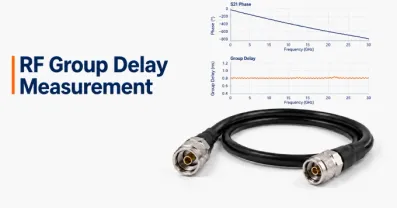
Group delay: Group delay describes the delay of a narrowband signal’s envelope and is calculated from the frequency slope of the transmission phase. RF group delay measurement reveals variations that can distort modulated signals.
What Does a Spectrum Analyzer Measure?
Signal frequency and level: Component frequencies and power levels are measured. dBm expresses absolute power relative to 1 mW; dBc expresses power relative to a carrier.
Harmonics and spurious signals: Harmonics occur at higher integer multiples of the fundamental frequency. Other unwanted discrete frequency components are called spurs.
Noise and noise density: Noise power is measured within a specified bandwidth. Noise density, usually expressed in dBm/Hz, gives noise power per hertz.
Channel power and bandwidth: Channel power is integrated over a defined band. Occupied bandwidth contains a specified percentage of total signal power, while adjacent-channel measurements quantify power in neighboring bands.
Phase noise: Supported measurements report single-sideband phase-noise levels in dBc/Hz at specified offsets from the carrier. These levels characterize random phase fluctuations.
Modulation quality: Vector analysis enables error vector magnitude (EVM) measurements. EVM quantifies the normalized error between measured and ideal modulation vectors, including magnitude and phase errors.
When to Use VNA vs Spectrum Analyzer?
VNAs are used to develop and verify RF devices, while spectrum analyzers evaluate generated signals and investigate interference in receivers and wireless systems.
When to Use a Network Analyzer
Antenna tuning and matching: During antenna development, a VNA shows how changes to the antenna or its matching network affect the match across the intended operating band.
Filter characterization: A VNA reveals whether a filter meets its passband, rejection, matching, phase, and group-delay specifications. These measurements support filter tuning and acceptance testing.
Cable and interconnect verification: Completed assemblies are tested with a VNA to verify their loss, matching, and phase response. The measurements also support investigations of suspected interconnect faults.
Amplifier and RF circuit characterization: A VNA evaluates gain, input and output match, and reverse isolation during circuit development or acceptance testing. The results show whether the device performs as specified.
The same tests can be repeated to compare prototypes or verify production units against common acceptance limits.
When to Use a Spectrum Analyzer
Interference troubleshooting: The spectrum reveals unwanted signals in or near a receiver’s operating band. Their frequencies and levels help explain degraded reception or an unreliable wireless link.
Transmitter evaluation: A transmitter’s output is examined to verify carrier power, occupied bandwidth, adjacent-channel emissions, and spurious outputs against its specifications.
Amplifier distortion testing: A spectrum analyzer reveals harmonics under single-tone excitation and intermodulation products under two-tone excitation. These tests assess distortion at the amplifier’s intended operating power.
Oscillator and signal-source evaluation: Oscillators and signal generators are evaluated for unwanted spectral components and phase noise. These tests establish whether the source meets the system’s spectral-purity requirements.
Intermittent-signal investigation: Real-time analysis or I/Q recording allows bursts and frequency-hopping signals to be examined. Their timing and changing frequency content help explain intermittent system behavior.
Limitations of Network Analyzers and Spectrum Analyzers
A VNA’s accuracy depends on its calibrated test path and the DUT’s operating conditions. A spectrum analyzer’s receiver performance and acquisition method determine which signals it can resolve and capture.
VNA Limitations
Calibration and test-path stability: Calibration corrects systematic errors at the reference planes, the connection points to which the reported response applies. Cable movement, differences between connector matings, and temperature drift can change the test path after calibration. Receiver noise also limits repeatability.
Active-device and nonlinear behavior: An amplifier’s measured response depends on its bias and applied signal level. Ordinary small-signal S-parameters describe approximately linear behavior around that operating point; they do not fully characterize compression, harmonics, or intermodulation.
Antenna performance: A good match shows that little power is reflected at the feed. It does not establish radiation efficiency or gain, because accepted power can also be dissipated as heat.
Spectrum Analyzer Limitations
Resolution and acquisition time: A narrower resolution bandwidth (RBW) helps distinguish closely spaced signals and reduces displayed noise power. It generally increases measurement time, particularly in swept measurements.
Receiver performance: Strong inputs can overload the receiver or produce distortion inside the analyzer. The noise floor hides sufficiently weak signals, while receiver phase noise can obscure components close to a strong carrier. These effects limit usable dynamic range.
Event capture: A swept analyzer measures different frequencies at different times, so it can miss a brief signal while tuned elsewhere. Frequency coverage defines the tuning range; instantaneous analysis bandwidth defines how much spectrum is captured at once. Real-time capture operates within a specified bandwidth and has limits on the shortest events it can reliably detect.
For both instruments: Frequency coverage and permitted RF power and DC voltage define the operating limits. Cables, adapters, and fixtures can also contribute loss, mismatch, and phase shifts to the measured result.
Can You Use a VNA as a Spectrum Analyzer?
A standard VNA is not a general replacement for a spectrum analyzer. Its ordinary measurements characterize a device’s response to a controlled test signal. A spectrum analyzer examines the frequency components of an input signal, including signals generated independently of the instrument. Some instruments provide both functions through separate measurement modes.
Why a VNA’s receiver is not enough
A VNA contains receivers, but displaying receiver power does not automatically provide reliable spectrum analysis. During ordinary network measurements, the instrument knows the frequency of its test stimulus. A spectrum analyzer must distinguish input signals at different frequencies while suppressing unwanted responses generated within its own receiver.
Without a specified spectrum-analysis function, a VNA may display misleading responses when examining unknown signals. A receiver-power reading alone therefore does not establish that it can accurately measure harmonics, spurious signals, or noise.
Both can measure a filter’s insertion loss versus frequency
A VNA measures the filter’s transmission response, including its passband shape and attenuation outside it. A spectrum analyzer with a tracking generator measures the filter’s output as the test frequency is swept.
The spectrum analyzer’s results are normalized against a through measurement to account for the test path’s magnitude response. This allows the filter’s insertion loss to be displayed rather than its output power alone.
Full VNA calibration also corrects systematic transmission and mismatch errors. The VNA provides transmission phase; the ordinary tracking-generator measurement does not. The resulting measurement uncertainties can also differ.
A VNA can determine complex antenna impedance for matching
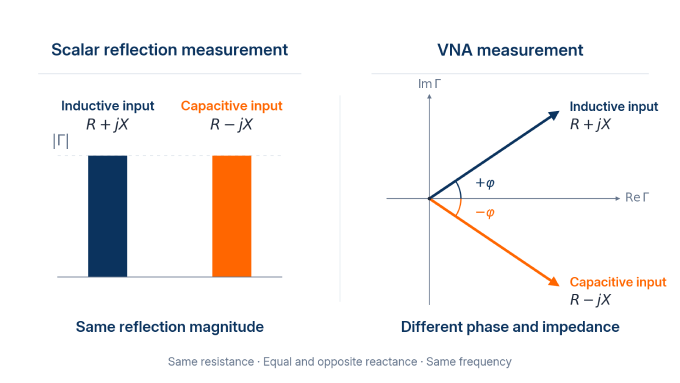
Determining complex antenna impedance requires reflection magnitude and phase. A VNA measures both, allowing resistance and reactance to be calculated.
An ordinary spectrum analyzer with a tracking generator and reflection bridge measures only reflection magnitude. Different combinations of resistance and reactance can produce the same reflection magnitude, so the scalar result cannot uniquely determine the antenna’s impedance.
Some instruments include both genuine VNA and spectrum-analysis modes and can perform both kinds of measurement. For these instruments, check the specifications of the spectrum-analysis mode itself; the presence of VNA receivers alone does not establish equivalent capability.
Should You Invest in a Vector Network Analyzer?
Buying a VNA makes sense when its capabilities are needed regularly, and immediate access improves development or testing enough to justify the cost.
Do the required results need vector measurements? Complex impedance, transmission phase, group delay, and the complete calibrated response of a multiport device are reasons to seek VNA capabilities. Magnitude-only measurements cannot provide all of that information.
Would a simpler measurement satisfy the requirement? A magnitude-only requirement can often be met by a scalar setup, as the filter example showed. A VNA adds useful capability when phase information or more complete error correction is needed.
What capabilities does the work require? Frequency range and port count determine which devices can be tested. Measurement uncertainty, dynamic range, and required functions determine whether an entry-level VNA can meet the specifications or a more capable instrument is needed.
Would access be sufficient, or would ownership add value? Frequent design iterations and routine production tests favor ownership because measurements are available whenever needed. Shared laboratory access, rental, or outsourced testing may suit occasional work, replacing a purchase with access fees, rental charges for the period of use, or charges per test. Ownership also requires staff capable of making and interpreting reliable measurements.
Why Are VNAs so Expensive?
VNAs are generally more expensive than basic spectrum analyzers because they combine a precision signal source, directional couplers or bridges, and multiple receivers. Those receivers must accurately compare the magnitude and phase of incident, reflected, and transmitted signals across the operating frequency range. Achieving this requires stable RF hardware and extensive calibration and error correction, making the instrument more complex to develop, manufacture, and test.
That complexity helps explain the higher price. Advanced signal analyzers can cost more than VNAs when they offer greater receiver performance, wider analysis bandwidth, or additional functions.
The instrument is only part of the setup cost. VNA calibration standards, test cables, and fixtures add to the budget, while spectrum analyzer measurements may require a source or reflection bridge. Software options, maintenance, periodic calibration, and training add further expenses. Used instruments often have lower purchase prices than comparable new models, with prices varying by condition and installed options.
Choosing Between a VNA and a Spectrum Analyzer
The choice depends on the measurement you need:
Choose a VNA to characterize a device’s reflection and transmission response, including matching, insertion loss, complex impedance, phase, and group delay.
Choose a spectrum analyzer to examine signal frequencies and power levels, identify interference, or measure harmonics, spurious signals, and noise.
Use both when the task requires both kinds of information. For example, evaluating an amplifier may require VNA measurements of gain and matching alongside spectrum analyzer measurements of distortion products.
Check frequency coverage, dynamic range, measurement uncertainty, and required functions against your test requirements. When comparing costs, include the cables, calibration standards, sources, and software options needed to complete those measurements.
FAQ
Discussion (0)
Be the first to comment.